Ordinals on Bitcoin
December 2022 – January 2023In December 2022 Casey Rodarmor made the first inscription on Bitcoin. His scheme, called Ordinals, numbers individual satoshis and lets a picture or any other file be written into a transaction and attached to one of them. The file then follows that satoshi as it is spent. The software was released for general use in January 2023 and a market for inscriptions formed within weeks.
Ordinals depends on being able to follow a coin from one transaction to the next. That is possible on Bitcoin and deliberately not possible on Monero, where every payment hides its real source among decoys drawn from other people's coins and amounts are hidden as well. Bringing inscriptions to Monero therefore needed a different way of saying who owns what.
The first inscriptions
March 2023The Mordinals project published a modified Monero node and wallet on GitHub as mooonero/mordinals. Its wallet placed a file in the extra field of a transaction, a part of every Monero transaction intended for small pieces of technical data. The inscription belonged to whoever held the first output of that transaction. The modified node kept an index of inscriptions, and an explorer at mordinals.org displayed them.
The first one was recorded in block 2,838,391 on 9 March 2023 at 19:01 UTC. It is a 993-byte picture with the description testing that.

Mordinal No. 0
24 by 24 pixels, 993 bytes. Inscribed 9 March 2023.
The first Monero Punk followed on 11 March as Mordinal No. 2. The Monero Punks account announced its first hundred on 13 March and said a week later that the collection had finished minting. Its website let a visitor choose a design that had not been inscribed yet and inscribe it themselves.


Mordinals Nos. 2–21. The first Monero Punks, inscribed on 11 March 2023.
The debate over the extra field
March – April 2023Monero developers had been discussing the extra field for some years before this. A proposal from 2020 considered removing it altogether, on the grounds that any data a transaction carries there can make it distinguishable from others. In February 2023, a few weeks before the first Mordinal, another proposal set a limit of 1,060 bytes on the extra data of transactions that nodes pass on before they are mined.
Mordinals made this a public argument. Some node operators objected to storing pictures in a network built for payments. Others asked what the inscriptions meant for people who only wanted to use Monero as money. The Mordinals developers replied that if the extra field were removed, data would move into other parts of a transaction.
On 16 March someone inscribed Mordinal No. 101, a small picture with the description REMOVE TX_EXTRA.
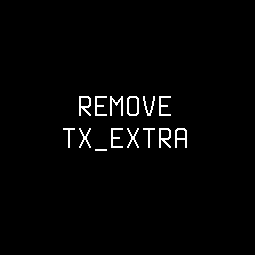
Mordinal No. 101
378 bytes. Inscribed 16 March 2023. Its whole extra field is 442 bytes, under the limit that was then being proposed.
The 1,060-byte limit was merged into Monero's code on 18 March and released to node operators on 10 April in version 0.18.2.2. It was not a change to the consensus rules. A block that had been mined could still contain a larger transaction, but upgraded nodes would not relay one, so a large inscription now needed a miner to include it directly.
The minting rush
25 March – 21 April 2023Until 24 March fewer than 3,000 Mordinals existed. In the eight days from 25 March to 1 April another 39,888 were inscribed, 6,710 of them on 27 March alone. Four collections of generated pictures, of about ten thousand each, account for almost forty thousand of all Mordinals.
On 2 April the Mordinals team published its first major release. It made transfers available to every user (a few test transfers had been made since 27 March) and introduced fees that rose steeply with the size of an inscription: by the team's own examples about 0.004 XMR for 1 KB and 0.2 XMR for 50 KB. An inscription that paid less was not recognised by the index. The number of new inscriptions fell from 3,692 on 1 April to 44 on 2 April and one on 3 April. The team later attributed the fall to this fee change.
Trading started at about the same time. Monero Punks announced what it called its first verified sale on 7 April, for 0.6 XMR, and reported another for 0.8 XMR on 12 April. There were 120 transfers in April, close to three quarters of all the transfers that were ever made.
The privacy cost
How a transfer workedA Monero input contains a ring of sixteen coins: the one being spent and fifteen decoys chosen from elsewhere on the chain. An observer cannot tell which of the sixteen is real, provided each decoy is as plausible as the real coin.
To transfer a Mordinal, the 2023 wallet spent the inscribed coin in a ring whose other fifteen members were a fixed set of outputs that nobody is able to spend. This let the index see which coin had moved, and it let everyone else see it too. A coin that is known to be spent cannot be the real coin in any later ring. When another wallet happens to pick it as a decoy, an observer can rule it out. Monero researchers call a decoy of this kind a black marble.
Inscribing had a similar effect without any transfer. An inscribed coin could be recognised on the chain, and its holder was unlikely to spend it in an ordinary payment, so a ring that included one as a decoy was probably not spending it.
Two studies measured this. An analysis published in April 2023, which counted Mordinal outputs together with mining outputs, put the lowest daily average effective ring size at 12.5 against a nominal 16. A paper from 2024 treated the first output of every Mordinal inscription or transfer as a decoy and found the assumption correct 99.79% of the time in the part of its data where it could be checked.
The people affected were ordinary Monero users who had nothing to do with Mordinals. This is the main reason the design was opposed, and it is the problem any successor had to avoid.
Decline
May 2023 – 2026After April there was little activity. The index records three transfers in May 2023, four in June, two in July and 29 in December. The last of them moved Mordinal No. 1397 in block 3,045,217 on 22 December 2023. The original software received its last update in April 2023.
- Mordinals under the original rules
- 42,894
- Transfers, all in 2023
- 164
- Mordinals that were ever transferred
- 139
- Still on the coin they were inscribed on
- 42,755
The websites lasted longer than the activity. In September 2024 the gallery at moneropunks.com was replaced by a single animated image. The explorer at mordinals.org was still answering requests in 2025 and no longer did by November 2026. The Mordinals handbook was online in July 2026 and had been removed by November.
None of this affected the inscriptions, which are part of the Monero chain and cannot be removed from it. What a holder lost was the means of using them. Without the hosted explorer, seeing or moving a Mordinal meant building and synchronising the 2023 software, there was no longer anywhere to sell one, and no list had ever been published of which coin held which Mordinal.
The ownership index and XMR721
October – November 2026In October 2026 the XMR20 project published a searchable gallery of the Mordinals on xmr20.org, with each picture linked to the transaction that inscribed it.
In November it worked out which coin holds each one. This meant reading the chain from the first inscription onward, 36.8 million transactions, and running the original 2023 index code over it without modification. A second replay was written separately as a check. The two agree on all 42,894 Mordinals and all 164 transfers. The result, with the code that produced it, is published on GitHub. As far as we know it is the only complete public index of Mordinals and their holders.
XMR721 was then built on that index. It is a ledger of signed records carried in ordinary Monero transactions. The holder of a Mordinal claims it once to an ordinary Monero address. After that it is sent and sold by messages signed in a wallet, and the owner's coins are not involved.
- Ledger start
Claims, sends, listings and sales count from this block. Every Mordinal keeps its number and history.
- Minting opened to everyone
New collections and NFTs on the same ledger, from one's own wallet or through the relay.
- Claiming by burning
A Mordinal is claimed with one transaction that retires its old coin, so that it cannot move under the 2023 rules again.
- Open XMR20 tokens
Anyone can create and mint a token, announced by an inscription on the ledger.
- Claims from Feather
A Feather user sends the coin to themselves and signs a claim. The seed stays in Feather.
A claim exposes the Mordinal's old coin once, in the same way a 2023 transfer did. Nothing after the claim touches a ring, and NFTs minted under XMR721 never involve a coin at all.
Ownership under XMR721 rests on people agreeing to its rules, as it does with Ordinals. Nobody can prevent a different index with different rules. For that reason the rules, the index and the reader are public, and anyone can run a reader on their own node and compare the result.
On 5 November 2026 the project also mined block 3,799,494 with a 598,000-byte video in its reward transaction. By the project's own scan it is the largest block on the Monero chain. The original rules read only ordinary transactions, so it is not a Mordinal, and XMR721 lists it as a single added entry after them.
Mordinals were created in 2023 by the authors of mooonero/mordinals. The inscriptions belong to them and to their holders. XMR721 does not alter them, and the name Mordinals remains theirs.
Sources
Counts are taken from the XMR721 ownership index. Dates and events are from the public record.
- mooonero/mordinals, the original node and wallet
- XMR721 ownership index, method and results
- Casey Rodarmor's blog on Ordinals
- Monero issue #6668, on removing the extra field (2020)
- Monero pull request #8733, the 1,060-byte limit
- Monero 0.18.2.2, released 10 April 2023
- Mordinals release of 2 April 2023, with fee examples
- Monero Punks, sale of 7 April 2023
- Monero Research Lab log, 15 March 2023
- MoneroTopia, 18 March 2023
- Rucknium, effective ring size analysis, April 2023
- Hammad and Victor, on Monero traceability, 2024
- moneropunks.com in September 2024, Internet Archive
- mordinals.org in November 2025, Internet Archive
- XMR20 update of 14 November 2026
- XMR20 update of 17 November 2026